Fewer new products despite rising exports
Some French vaping industry professionals have noticed a trend: new e-cigarette models are becoming increasingly scarce as 2026 draws to a close. This stands in stark contrast to previous years, when new products were arriving on the market almost every week.
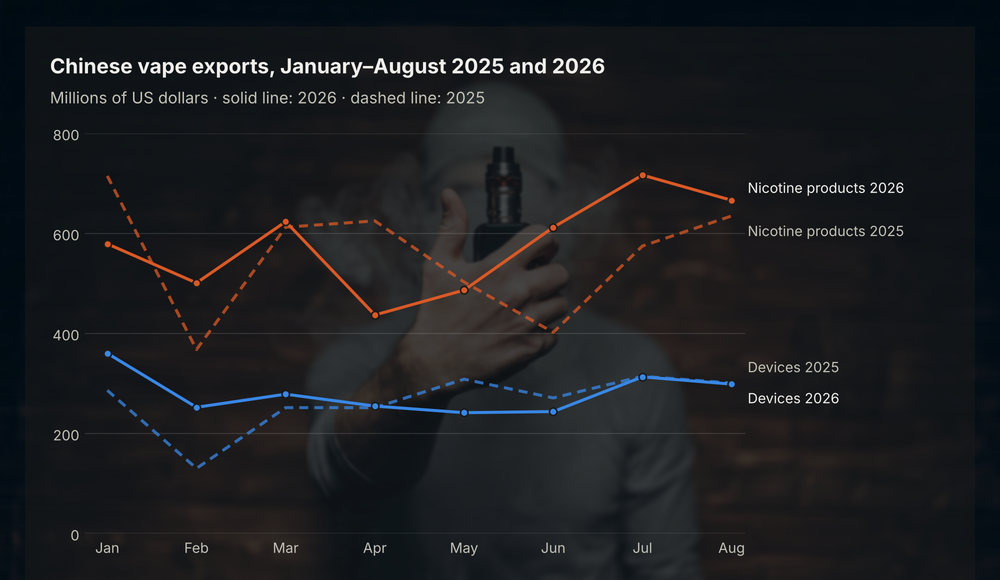
Yet according to Chinese customs data, exports of nicotine-containing products (disposable vapes, prefilled pods and e-liquids) rose by 4.2% over the first eight months of 2026, reaching $4.62 billion. Exports of vaping and heated tobacco devices increased by 6.1% to $2.24 billion, although they have remained below their 2025 levels every month since May (-8.2% from May to August). So how can this lack of new products be explained?
| Month | Nicotine products 2025 | Nicotine products 2026 | Change | Devices 2025 | Devices 2026 | Change |
|---|---|---|---|---|---|---|
| January | 715.0 | 579.2 | -19.0% | 286.4 | 360.4 | +25.8% |
| February | 367.9 | 501.1 | +36.2% | 130.4 | 252.5 | +93.7% |
| March | 612.6 | 623.6 | +1.8% | 251.8 | 278.7 | +10.7% |
| April | 625.1 | 437.0 | -30.1% | 251.7 | 254.9 | +1.3% |
| May | 502.9 | 486.7 | -3.2% | 308.7 | 241.7 | -21.7% |
| June | 402.3 | 612.3 | +52.2% | 271.2 | 243.9 | -10.1% |
| July | 574.9 | 716.7 | +24.7% | 314.5 | 313.3 | -0.4% |
| August | 635.0 | 666.3 | +4.9% | 300.9 | 298.8 | -0.7% |
| Total | 4,435.7 | 4,622.9 | +4.2% | 2,115.5 | 2,244.3 | +6.1% |
| Figures in millions of US dollars. Nicotine products: HS code 24041200 (disposable vapes, prefilled pods, e-liquids). Devices: HS code 85434000, including heated tobacco devices. Source: General Administration of Customs of China. | ||||||
The sharp decline in nicotine product exports in April (-30.1%) could be explained by China’s removal of VAT export rebates for these products on 1 April 2026. For vaping hardware, however, these rebates will not be abolished until April 2027, meaning their removal cannot explain the decline in device exports observed since May. The answer may instead lie in Article 11 of Regulation (EU) 2023/1542, which will apply from 18 February 2027.
Removable batteries will become mandatory
Article 11 stems from a regulation proposed by the European Commission on 10 December 2020 as part of the European Green Deal. The regulation replaces a 2006 directive on batteries, which required batteries to be removable from devices either by the user or by a qualified professional. After two years of negotiations before an agreement was reached between the European Parliament and the Council, the text was finally adopted by Parliament on 14 June 2023 and published in the Official Journal the following month.
And this article changes everything. The regulation states that “Any natural or legal person that places on the market products incorporating portable batteries shall ensure that those batteries are readily removable and replaceable by the end-user at any time during the lifetime of the product.” It further specifies that a battery is considered readily removable “where it can be removed from a product with the use of commercially available tools, without requiring the use of specialised tools, unless provided free of charge with the product, proprietary tools, thermal energy, or solvents to disassemble the product.”
This provision will therefore require e-cigarette manufacturers, among others, to equip their products with batteries that vapers can easily replace themselves. A requirement that most devices currently on the market do not meet.
The six-month notification trap
It is also worth remembering that the EU Tobacco Products Directive (TPD) requires all new vaping products to be notified six months before they can be placed on the market. A new e-cigarette with a built-in battery notified in June 2026, for example, could not be launched before December 2026, leaving only around two months for imports before Article 11 takes effect. Only stock already delivered to distributors could then continue to be sold.
This could explain the slowdown in new vaping product launches. At least until manufacturers adapt their devices to the new regulation, bearing in mind that any substantial modification to a product also requires a new notification, triggering another six-month waiting period.