
A study based on assumptions
While scientists continue to investigate the long-term health effects of e-cigarettes, a team of researchers set out to simulate “plausible ranges of lifetime mortality outcomes for a single-year birth cohort exposed to e-cigarettes from the beginning of their use among adolescents through their peak prevalence today.” In other words, the scientists modeled the lifetime trajectory of all American adolescents who were 12 years old in 2016. The year was not chosen at random: this cohort was entering adolescence “when youth e-cigarette use became widespread” and was aged 14–15 during the “peak of youth vaping in 2018–2019,” ages at which experimentation with different products, such as smoking or vaping, is common.
In 2016, more than four million Americans (4,139,869) were 12 years old. Three ways in which vaping could affect their mortality were incorporated into the research model1:
- adolescents who vape and go on to smoke as adults;
- adolescents who vape and continue vaping into adulthood without ever smoking;
- adolescents who smoke and, as adults, quit smoking more often thanks to vaping than they would have if e-cigarettes had never existed.
The researchers then compared two scenarios for this entire population. In the first, the “real-world” scenario, e-cigarettes exist and are used at the levels observed in U.S. national surveys. In the other, “counterfactual” scenario, vaping never existed, and each young person was modeled as a potential conventional smoker, with no possibility of quitting smoking with the help of vaping.
Comparing the two scenarios
To populate these two scenarios, the researchers relied on the National Youth Tobacco Survey (NYTS), the benchmark survey on tobacco and vaping use among young Americans, following the cohort from age 12 in 2016 to age 17 in 2021.
In the real world, by age 20 in 2024, there were 141,057 smokers and 441,393 vapers who had never smoked. Some of these smokers—just over one-third—had first vaped before taking up smoking, while the rest had never used e-cigarettes.
In the counterfactual scenario, in which vaping did not exist, the researchers applied only the rate of smoking initiation observed among young people who had never vaped. They estimated that 116,018 members of the cohort would still have become smokers by age 20.
The existence of vaping would therefore have “created” 25,039 additional smokers: 141,057 smokers in the real world with vaping, compared with 116,018 simulated smokers in a world without e-cigarettes. This figure reflects several phenomena that the researchers cannot disentangle: the gateway effect, meaning young people who start by vaping and later begin smoking, and young people who simply have higher-risk profiles and would have smoked anyway, whether or not vaping existed.
These population figures—141,057 smokers and 441,393 vapers in the real world, and 116,018 smokers in the “imaginary” world—were then used to simulate, individual by individual, the life expectancy of each group.
Mortality in each group
The researchers then virtually followed each profile—smoker, exclusive vaper, former smoker who switched to vaping, and so on—over an entire lifetime, year by year.
The principle was simple: for each year of a simulated life, a random draw determined whether the person stopped smoking or vaping, and whether they died during that year. The figures used in the simulation were based on real-world probabilities. For example, smoking mortality risk was derived from a large long-term U.S. cohort study that measured mortality risk according to age and the number of years since smoking cessation. The spontaneous smoking cessation rate was set at 5.5% per year, again based on another study2.
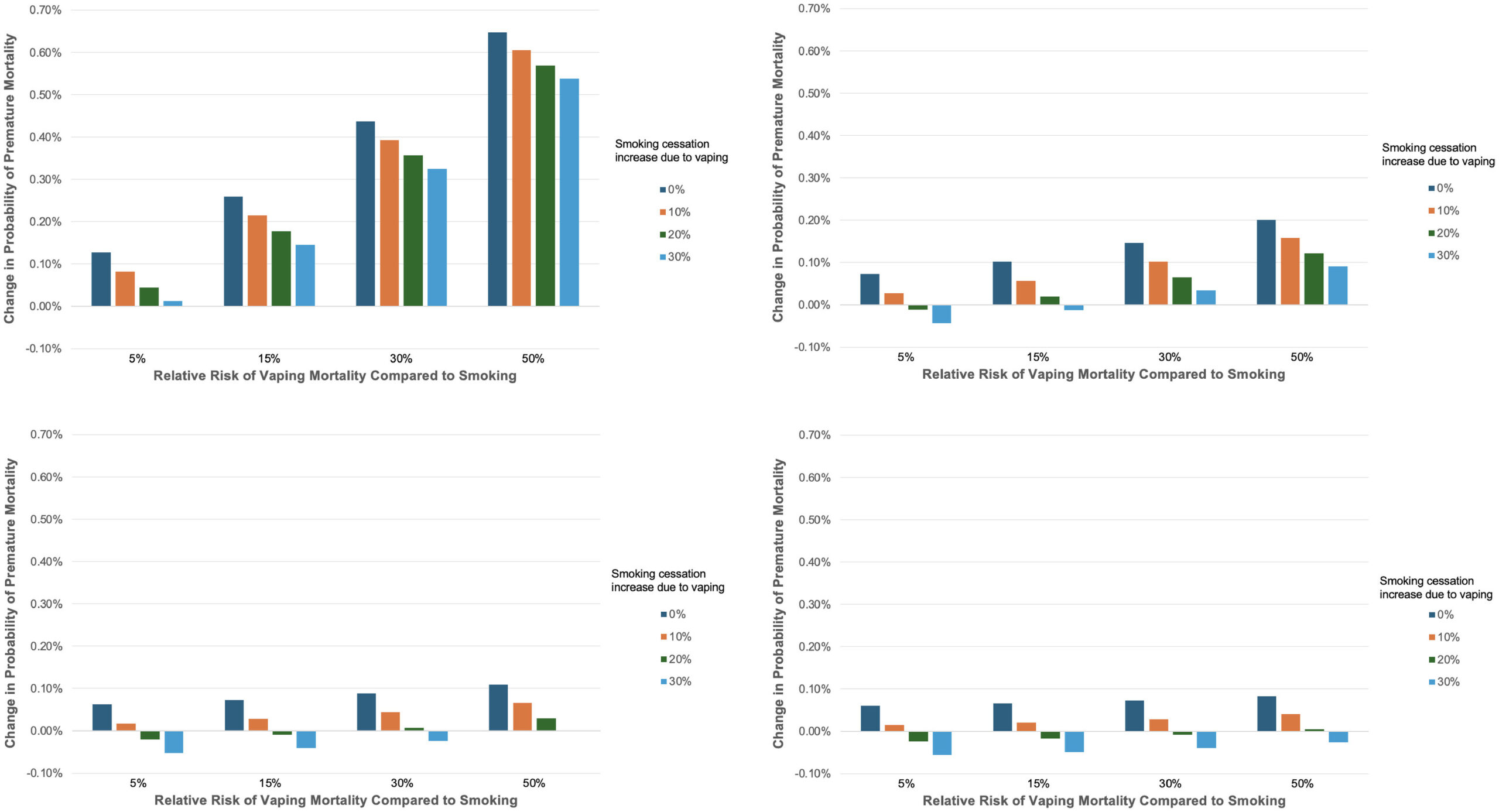
For vaping, because long-term mortality data are lacking—which is precisely the problem the study was designed to work around—the researchers made several assumptions. They varied four parameters, each across several values, and tested every possible combination:
- the mortality risk of vaping relative to smoking: 5%, 15% or 30% (with an additional test at 50%, considered unrealistic by the experts consulted but included as a precaution);
- the vaping cessation rate: from 5.5% per year (the same as smoking) up to 22% (four times faster);
- the increase in smoking cessation attributable to vaping: from 0% (vaping does not help people quit smoking at all) to a 30% greater chance of quitting;
- the average duration of vaping after successfully quitting smoking with the help of e-cigarettes: 5, 10 or 20 years, before the person also stopped vaping.
Each combination of these four parameters constituted a separate scenario, and each scenario was repeated 10 million times for the same individual in order to smooth out random effects and obtain a stable estimate of their probability of premature death and the number of life-years lost, compared with a virtual twin who had never smoked or vaped.
It should also be noted that, in the model, when someone quit smoking with the help of vaping, their mortality risk did not decline as quickly as it would have if they had quit smoking without subsequently smoking or vaping anything. The researchers slowed the decline in risk in proportion to the level of risk attributed to vaping. For example, if vaping was assumed to be 30% as risky as smoking, the reduction in mortality risk after smoking cessation was slowed by 30% for as long as the person continued to vape.
This process, repeated for each subgroup—conventional smokers, exclusive vapers, former smokers who switched to vaping—and for each of the dozens of parameter combinations, produced the study’s results.
The results
Regardless of the assumptions used, the effect of vaping on mortality across the entire cohort always remained very small.
In the scenario least favorable to e-cigarettes—vaping risk estimated at 30% that of smoking, no effect on smoking cessation, and vaping cessation occurring at the same slow rate as smoking cessation—the probability of premature death for a young person increased by 0.44 percentage points.
Under the scenario most favorable to vaping—vaping risk estimated at 5% that of smoking, a 30% increase in smoking cessation success attributable to vaping, and vaping cessation occurring four times faster than smoking cessation—the probability of premature death decreased by 0.06 percentage points.
Expressed in days of life, these figures suggest that the existence of e-cigarettes would result in between 0 and 31 days of life lost, depending on the assumptions used. Under some assumptions, vaping would even result in a small gain in life expectancy.
This raises an obvious question: why is the effect so small? The answer is simple: the various effects of vaping largely cancel each other out.
On the one hand, vaping could lead some young people to smoking, which would have a negative health impact. On the other, vaping may have enabled some smokers to quit smoking, which would have a positive health impact. Finally, most vapers in this cohort had never smoked, and for them the risk associated with vaping alone is far lower than that of smoking. Across a population of more than four million young people, these three effects broadly offset one another.
The study’s most striking figure instead concerns the effect of vaping at the individual level. A young person who smokes would have an approximately 7–8% risk of dying prematurely. A young person who vapes but has never smoked would have a risk ranging from 0.15% to 0.84%, depending on the assumptions used. In other words, their risk of premature death would be 10 to 50 times lower than that of a smoker.
Limitations of the study
The study has several limitations, which the authors themselves acknowledge:
- The model used by the researchers completely ignores non-fatal diseases, including respiratory and cardiovascular effects. The scientists justify this choice by the complexity of incorporating such outcomes into their simulation and by their decision to focus on the most serious outcome: death;
- By applying the lowest smoking initiation rate to the entire counterfactual population, the researchers probably underestimated the number of young people who would have smoked even if vaping had never existed;
- The definition of a “regular smoker” was very broad, meaning that the number of actual smokers was probably overestimated;
- The model treats all vapers in the same way: as intensive users. In reality, some young people may vape only occasionally. The risks associated with vaping were therefore probably overestimated;
- The 25,039 additional smokers attributed to vaping combine a potential genuine gateway effect with young people who would have smoked anyway. The reverse possibility is also ignored: young people who took up vaping instead of smoking because e-cigarettes existed;
- Finally, the period studied ran from 2016 to 2024, and e-cigarettes evolved over the course of that period. Some devices now deliver more nicotine, which could make them more addictive but also more effective for smoking cessation. Neither of these developments was taken into account by the model used in this study.
Despite these limitations, the authors point out that most of them bias the model toward being more unfavorable to vaping. A model corrected for these biases would therefore probably produce a result that was even more favorable—or at least no less favorable—than the one obtained.
They conclude that, regardless of the combination of assumptions used, adolescent vaping in this cohort is “very unlikely to be an important source of lifetime premature mortality.”
Sources and references
1 Warner, K. E., Sun, R., Brouwer, A. F., & Méndez, D. (2026). The lifetime mortality implications of vaping and smoking initiated during adolescence. American Journal of Preventive Medicine, 108547. https://doi.org/10.1016/j.amepre.2026.108547
2 David Méndez, Thuy T T Le, Kenneth E Warner, Monitoring the Increase in the U.S. Smoking Cessation Rate and Its Implication for Future Smoking Prevalence, Nicotine & Tobacco Research, Volume 24, Issue 11, November 2022, Pages 1727–1731, https://doi.org/10.1093/ntr/ntac115