In summary
After analysing 80 randomised trials, Cochrane’s lead author says that, based on the consistency of the findings, nicotine e-cigarettes are “a proven and viable option for people wishing to quit traditional cigarettes.”
This added effectiveness translates into 4 more people quitting smoking per 100 (95% CI: 1 to 7 more), a 61% higher relative chance of quitting compared with nicotine replacement therapy (RR 1.61).
| Review date | Relative risk (95% CI) | Number of studies | Certainty | Notes |
|---|---|---|---|---|
| August 2026 | RR 1.61 (1.23–2.12) | 80 studies (29,861 participants) | High | Scope narrowed to randomised trials only (non-randomised studies removed from the count); 9 new trials included |
| November 2025 | RR 1.55 (1.28–1.88) | 104 studies (30,366 participants) | High | Slight adjustment of the estimate with more studies |
| January 2025 | RR 1.59 (1.30–1.93) | 90 studies (29,044 participants) | High | Results stable compared with January 2024 |
| January 2024 | RR 1.59 (1.29–1.93) | 88 studies (27,235 participants) | High | Estimates stabilise; narrower confidence intervals |
| November 2022 | RR 1.63 (1.30–2.04) | 78 studies (22,052 participants) | High | First review to reach high certainty for the comparison with NRT |
| October 2020 | RR 1.69 (1.25–2.27) | 50 studies (12,430 participants) | Moderate | First clear signal of greater effectiveness than NRT; certainty limited by imprecision |
| A relative risk (RR) of 1.61 means that the chances of quitting smoking with an e-cigarette are 61% higher than with nicotine replacement therapy. The 95% confidence interval (95% CI) shows the range in which the true value probably lies, here between 23% and 112% higher. | ||||
Contents
E-cigarettes may be the most effective tool for quitting smoking
Cochrane regularly reviews the latest scientific research on how effective e-cigarettes are for quitting smoking. This article is updated each time a new version of the review is published.
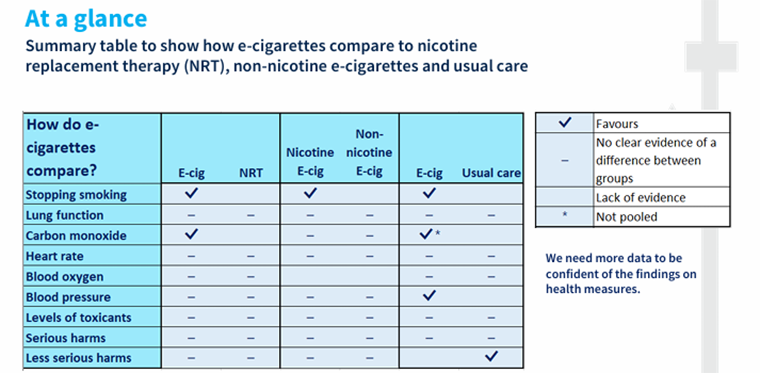
| Vaping vs nicotine replacement therapy | E-cigarette | NRT* | Nicotine e-cig | Nicotine-free e-cig | E-cigarette | Usual care |
| Quitting smoking |
✔ |
✔ |
✔ |
|||
| Lung function | = | = | = | = | = | = |
| Carbon monoxide |
✔ |
= | = |
✔ |
||
| Heart rate | = | = | = | = | = | = |
| Blood oxygen | = | = | = | = | ||
| Blood pressure | = | = | = | = |
✔ |
|
| Levels of toxic substances | = | = | = | = | = | = |
| Serious harms | = | = | = | = | = | = |
| Less serious harms | = | = | = | = |
✔ |
Table key:
✔: favours
=: no clear evidence of a difference between groups
x: worse results
: lack of data
NRT*: nicotine replacement therapy, the nicotine products usually used to quit smoking, such as patches and chewing gum.
A continuously updated review
The August 2026 update changes the way the researchers include studies in the systematic review. This time, the authors removed non-randomised studies from the total count.
This 11th version therefore covers 80 randomised trials, 9 of them new since the November 2025 version.
In the press release accompanying the update, Cochrane confirms that “nicotine e-cigarettes, commonly known as vapes, are more effective in helping people quit smoking” than many conventional methods, such as nicotine gum and patches, or quitting with or without behavioural support.
In their conclusions to this eleventh version, the authors report high-certainty evidence that nicotine e-cigarettes increase quit rates compared with nicotine replacement therapy, and moderate-certainty evidence that they probably increase quit rates compared with nicotine-free e-cigarettes.
Dr Jamie Hartmann-Boyce, the review’s lead author, says that based on the consistency of the findings, nicotine e-cigarettes are “a proven and viable option for people wishing to quit traditional cigarettes.” As the release puts it: “This update includes 9 new trials and our main conclusions haven’t changed.”
A review that addresses the WHO’s concerns
While the press releases for previous versions simply reported the results of each update, this one is a little different: some of the authors address the concerns that several countries and the WHO have raised about vaping.
The release notes that “many major health organizations and bodies including the WHO” warn that e-cigarettes “still expose users to nicotine and other chemicals which can be harmful”, and that there are fears “e-cigarette use by children and youth can lead to nicotine addictions” and to smoking tobacco products.
On this point, the authors caution that “e-cigarettes aren’t necessarily the best way for everyone looking to quit smoking” and that people should contact stop-smoking services or their clinicians for advice. They point out, however, that while vaping also carries health risks, “those risks pale in comparison to the dangers of smoking.”
“Quitting smoking is hard and a lot of people who smoke will have tried many times” without success, explained Dr Nicola Lindson, one of the review’s lead authors, which is why it matters that a range of options exists to keep people trying. “Although nicotine vapes are unlikely to be completely risk free, they are less harmful than smoking”, she added, and “that is the most important comparison to make for people who are still smoking tobacco.”
Dr Hartmann-Boyce, for her part, pointed out that the review only covers regulated e-cigarettes and that “many of those available on the market do not meet these standards.” She therefore advises smokers to buy only products tested and approved by their country’s regulator. “For somebody who is already addicted to nicotine through cigarettes”, she adds, a safer alternative such as an e-cigarette is worth considering, especially when other quit-smoking aids have failed.
Vaping almost twice as effective for quitting smoking

In early 2019, a study1 published in the New England Journal of Medicine concluded that vaping is almost twice as effective for quitting smoking as nicotine replacement therapies (patches, chewing gum, etc.).
Cochrane has now published a systematic review2 on the use of e-cigarettes for quitting smoking. Its aim was to find out how many people stopped smoking for at least 6 months by vaping, and how many experienced side effects.
The authors identified 90 studies covering a total of 29,044 adult smokers. All the studies reviewed compared vaping with different alternatives:
- Patches or chewing gum.
- Varenicline.
- Nicotine-free e-cigarettes.
- Heated tobacco.
- Behavioural support.
- No support.
The studies came from the United States (39 studies), the United Kingdom (20), Italy (9), Australia (5) and Greece (4), plus one study each from Belgium, Ireland, the Netherlands, Poland, South Korea, South Africa and Turkey.
Conclusions: vaping helps people quit smoking
After carrying out a meta-analysis of all the studies identified, the authors found that:
- There is high certainty that quit rates are higher among people given an e-cigarette than among those who used nicotine replacement therapy.
- Nicotine e-cigarettes may help more people quit smoking than no support or behavioural support alone.
- For every 100 people using nicotine e-cigarettes to quit smoking, 8 to 10 might succeed, compared with only 6 in 100 people using nicotine replacement therapy or nicotine-free e-cigarettes.
- Vaping does not cause more side effects than nicotine replacement therapies.
Notes and references
1 Hajek P, Phillips-Waller A, Przulj D, et al. A randomized trial of e-cigarettes versus nicotine-replacement therapy. N Engl J Med. 2019;380(7):629-637. DOI: 10.1056/NEJMoa1808779
2 Hartmann-Boyce J, McRobbie H, Lindson N, Bullen C, Begh R, Theodoulou A, Notley C, Rigotti NA, Turner T, Butler AR, Hajek P. Electronic cigarettes for smoking cessation. Cochrane Database of Systematic Reviews 2020, Issue 10. Art. No.: CD010216. DOI: 10.1002/14651858.CD010216.pub4.