- A publicly funded randomised trial conducted in the United Kingdom among 1,170 smokers compared three approaches to quitting smoking;
- At six months, 11.3% of participants who received a vape kit without follow-up had quit smoking, compared with 6.4% of those who received support emails;
- With four weeks of telephone follow-up, the quit rate rose to 21.1%;
- Most participants who quit smoking were still vaping after one year, using e-liquids with less and less nicotine.
An open question
There is no longer any doubt that e-cigarettes help people quit smoking: the Cochrane review, which pools the randomised trials on the subject, concludes with high certainty that they outperform nicotine replacement therapy. However, most of these trials provided vaping alongside multi-session behavioural support. This was the case, for example, in the British trial published in 2019 in the New England Journal of Medicine, in which vaping, combined with four weeks of face-to-face support, was almost twice as effective as nicotine replacement therapy (18.0% quit at one year versus 9.9%).
But such support is not always available, nor wanted by smokers. Cochrane also considers the evidence comparing vaping with behavioural support alone or no support to be less reliable, because of how the available studies were designed. This is precisely the question a new trial from Queen Mary University of London set out to answer. The trial was published in NEJM Evidence and funded by the NIHR, the UK’s public health research institute.
Three groups compared
The researchers recruited 1,170 adults who smoked daily and wanted to quit. Participants smoked an average of 19 cigarettes a day, were 48 years old on average, and most had already tried stop-smoking treatments. They were randomly assigned to one of three groups:
- The first received automated emails from the NHS SmokeFree programme, with advice and daily motivational messages for 28 days;
- The second received a vape kit by post, with a single explanation of how to use it;
- The third received the same kit, plus a phone call on their quit day and then a weekly call for four weeks.
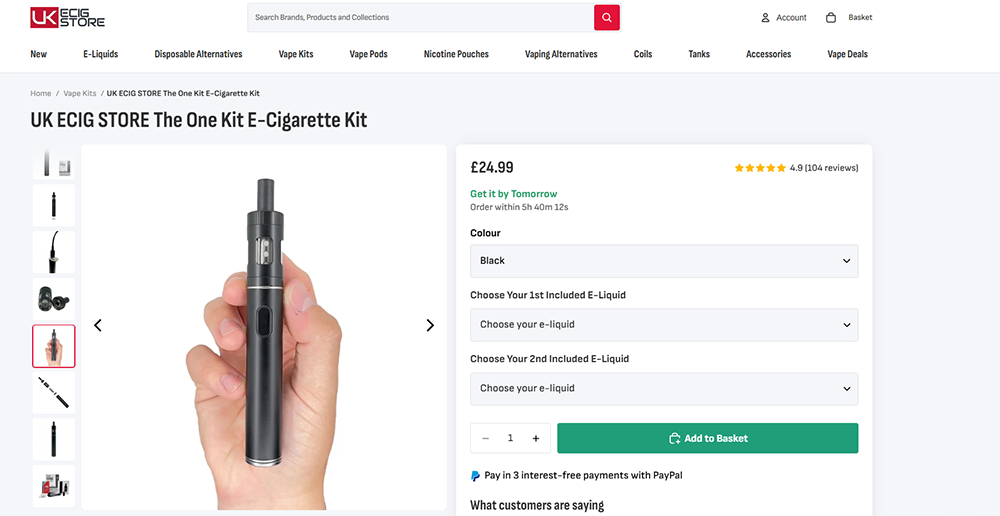
The kit consisted of a battery and a tank, two 10 ml bottles of e-liquid at 18 mg/ml (tobacco and strawberry flavours), five spare coils and a guide to buying more supplies. It was expected to last around two weeks, after which participants bought whatever they needed themselves.
The study’s primary outcome was demanding: continuous abstinence at six months, validated by measuring carbon monoxide (CO) in exhaled breath. Participants lost to follow-up were counted as still smoking.
Results at six and twelve months
| Outcome | Emails (n = 389) | Vape only (n = 389) | Vape + support (n = 388) |
|---|---|---|---|
| Validated quit at 6 months | 6.4% | 11.3% | 21.1% |
| Validated quit at 12 months | 5.4% | 9.0% | 16.8% |
| Vaping at 6 months | 21.9% | 50.6% | 59.5% |
| Source: Myers Smith et al., NEJM Evidence, 2026. Continuous abstinence validated by CO measurement; participants lost to follow-up counted as smokers. | |||
At six months, participants given a vape alone were 1.76 times more likely to have quit smoking than those in the email group. Adding telephone support increased these chances a further 1.87-fold compared with vaping alone. At one year, the effect of support still held, but the difference between vaping alone and emails was no longer statistically significant.
However, the email group appears to have been heavily “contaminated” by vaping: nearly a quarter of its participants were vaping at six months (24.4%), and 68% of those in this group who had quit smoking were using an e-cigarette. According to the authors, the main analysis therefore underestimates the gap with vaping alone. Excluding participants in the email group who vaped, the group’s quit rate would fall to 2.7%, four times lower than with vaping alone.
Among those who did not quit, vaping also appears to have helped reduce smoking: at six months, participants smoked on average 6.4 fewer cigarettes a day in the email group, 8.2 fewer with vaping alone and 9.6 fewer with vaping plus support.
Support that encourages vaping
Did telephone support really help? According to the authors, it mainly encouraged participants to use their vape early in their quit attempt: at four weeks, 74.2% of supported participants were still vaping, compared with 63.8% in the vape-only group. However, among those who had quit smoking, the proportion of vapers was similar in both groups. Support therefore seems to have encouraged the uptake of vaping rather than making vaping itself more effective.
The six-month quit rate in the vape plus support group remains lower than in the 2019 trial, which offered face-to-face support (21.1% versus 35.4%, according to the authors). At one year, the gap narrowed (16.8% versus 18.0%), which, in their view, suggests that the advantage of face-to-face support fades over time. On a less strict measure, no smoking in the previous seven days, the vape-only and vape plus support groups also came closer at one year (27.5% versus 32.6%).
Vaping that lasts
At one year, 83% of participants who had quit smoking were still vaping, a proportion similar to that of the 2019 trial. They were nevertheless lowering their nicotine intake: in the vape-only group, the median nicotine concentration fell from 12 mg/ml at four weeks to 6 mg/ml at one year, and nearly 5% of respondents were using a nicotine-free e-liquid at one year.
The authors acknowledge that long-term vaping probably carries respiratory and cardiovascular risks, even though these represent only a fraction of the risks of smoking. They also point out that continuing to vape can prevent a return to cigarettes: the only randomised trial available on the subject found fewer relapses among former smokers who vape.
A case for Swap to Stop
For the authors, these results support the British practice of providing free vape kits to people enrolled in stop-smoking services, whether or not they take part in multi-session support. Launched in 2023, the Swap to Stop programme entrusts these kits to local authorities.
Some limitations to bear in mind
Like all scientific studies, this one has several limitations.
First, the CO measurement used to validate smoking abstinence only detects smoking over the previous 24 hours.
The 2.7% rate put forward by the authors for the email group comes from an analysis that excludes those who vaped, that is, a large share of this group’s successes. The gap between the two groups may therefore be overestimated.
The results of this study cannot necessarily be applied worldwide, since the e-liquid provided was flavoured, and some countries have banned flavours other than tobacco.
Finally, participants, reassured by the trial setting, may have taken up vaping more readily than ordinary smokers, whereas in the UK 52% of smokers still believe vaping is as harmful as, or more harmful than, smoking. A limitation that above all shows how important it is to provide accurate information about the risks of vaping compared with smoking.