The lawsuit
Maine-based AJ Marketing LLC filed suit against Juul Labs on September 3, 2026, in the U.S. District Court for the District of Delaware (case No. 1:26-cv-01110). The complaint alleges that both the original JUUL and the newly authorized JUUL2 devices infringe U.S. Patent No. 8,851,068, titled “Personal Inhalation Devices.”
AJ Marketing is not a downstream licensing shell. It is the original assignee of the patent. The patent’s inventors, Scott A. Cohen and Michael J. Bedecs, assigned their rights to the company back in 2010, when the underlying application was filed. The patent issued on October 7, 2014.
According to the complaint, the technology traces back to an effort to deliver metered doses of caffeine to military pilots, pitched as a non impairing alternative to the amphetamines historically used to keep aircrews alert. But the patent’s claims are broader than caffeine delivery alone. It covers a personal inhalation device: an outer shell with an orifice, a reservoir holding a “medium,” and an atomizing unit that vaporizes the medium and doses it to the user on each puff. The patent explicitly lists nicotine, medications, vitamins and even THC (in permitting jurisdictions) as possible payloads alongside caffeine.
AJ Marketing alleges Juul’s heating and delivery system infringes those claims. The suit seeks a reasonable royalty covering the six years preceding the filing, plus an ongoing royalty through the patent’s expiration, estimated by Bloomberg Law at January 2031. Juul Labs has not yet responded in court.
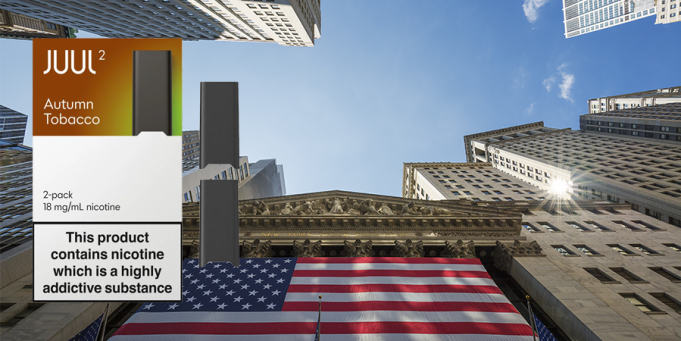
The lawsuit lands exactly a week after the FDA authorized the JUUL2 device and two accompanying pods through the Premarket Tobacco Product Application (PMTA) pathway, clearing Juul’s second generation platform for legal U.S. marketing. AJ Marketing named JUUL2 explicitly in its infringement claims, meaning Juul’s newly cleared product enters the market already tangled in litigation.
Not Juul’s first patent fight
Juul has spent much of the past two years on both sides of the patent litigation table against rival Altria and its NJOY subsidiary.
In August 2025, Juul filed a complaint with the U.S. International Trade Commission seeking to block imports of Altria owned NJOY Ace devices, alongside a parallel infringement suit in Delaware federal court. Juul argued the NJOY Ace, the only pod based device with FDA marketing authorization at the time, infringed its patents, and pointed to a perfect record in three prior ITC cases against counterfeit and unauthorized compatible products.
Altria’s NJOY unit answered with its own ITC complaint and a companion Delaware lawsuit, accusing Juul’s flagship JUUL device and JUULpods of infringing two patents that NJOY had acquired from Fuma International as part of a separate patent settlement.
Juul separately sued NJOY and Altria in Arizona federal court, alleging NJOY Daily infringed a Juul nicotine salt patent. That case took an unusual turn: newly unsealed filings showed an ITC judge had found that vaping products sold by R.J. Reynolds back in 2013 already contained every element of Juul’s asserted nicotine salt claims, evidence Altria and NJOY are now using to argue the patent lacked novelty and should be invalidated.
The bigger picture
This pattern of litigation on multiple fronts, in multiple forums (ITC, Delaware, Arizona), often running in both directions at once, has defined Juul’s relationship with Altria/NJOY since Altria fully divested its Juul stake in 2023 and later acquired NJOY’s competing product line without licensing Juul’s patent portfolio.
The AJ Marketing case is a departure from that pattern in one respect. AJ Marketing is not a competing vaping company but appears to be a pure patent holder, asserting a decade old patent with no vaping product of its own on the market, a profile closer to what’s commonly termed a non practicing entity than to an operating rival like NJOY.
Whether Juul challenges the patent’s validity, given its 2010 priority date and broad “personal inhalation device” claim language that predates the pod vape category as it exists today.
Whether AJ Marketing seeks an injunction or settles for royalties; the complaint as reported asks only for damages, not a sales ban.
Whether this becomes a template for other legacy inhalation patent holders to test claims against the now much larger and more valuable pod vape market, especially as JUUL2 rolls out under fresh FDA authorization.