The past year has laid bare a difficult truth for the UK, Ireland, much of Europe and the rest of the world, about the reality of steering nicotine policy away from harm reduction and toward prohibitionist strategies The unintended consequences arrive quickl, and often at the expense of the very people public health is meant to protect.
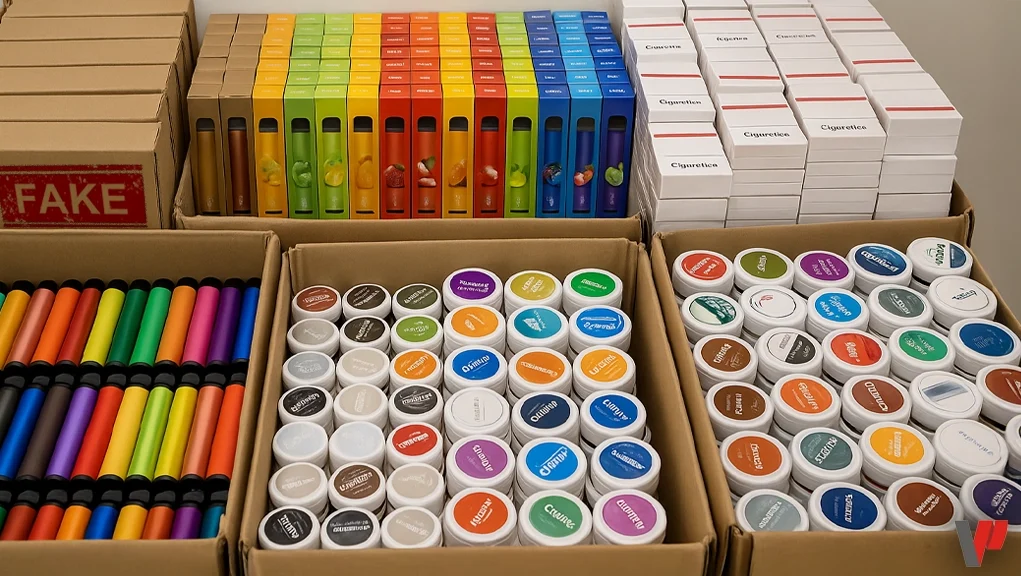
Across the UK, a sweeping national crackdown has exposed the formation of a massive illicit tobacco economy now worth billions. Between April 2023 and March 2024, enforcement teams seized 1.36 billion illegal cigarettes, translating to an estimated £678 million in lost revenue. In Lancashire, the problem has been especially visible. Under Operation Wanderstar, officers uncovered smuggled cigarettes hidden behind kick boards, inside fake cupboards and throughout backroom storage areas.
October’s raids alone recovered nearly £200,000 worth of contraband. Detective Sergeant Rob Costigan of Lancashire’s Economic Crime Unit emphasised that the concealment methods leave no doubt about criminal intent. Many packs lacked the legally required health warnings and sold for as little as £5. Officers also found counterfeit cash, illegal disposable vapes and huge quantities of “illegal whites”—products manufactured outside EU standards and often containing banned chemicals.
Experts warn that this illicit trade is not run by amateurs. Criminologist Professor Emmeline Taylor of City, University of London notes that the networks behind tobacco smuggling are deeply connected to wider criminal activity, including trafficking and money laundering. A BBC investigation further revealed how fraudulent directorships and exploited migrant labour allow criminal groups to operate convenience stores as fronts. Yet despite more than 2,700 enforcement visits and 920 arrests, penalties remain weak, usually amounting to fines of up to £10,000—an insignificant cost of doing business in a lucrative smuggling trade.
The unintended consequences governments ignore
Local tobacco harm reduction experts, such as Clive Bates, had long warned the UK, that this is exactly what would happen as a result of harsh restrictions. Referring to telling data from countries like Australia, such experts had consistently warned that making any product unavailable or inaccessible, just drives it underground, where it is unregulated and very likely unsafe.
The underlying drivers of this pattern in the UK are clear. With legal cigarettes now costing £14 to £18 per pack—the highest prices in Europe—and disposable vapes banned, millions of consumers are turning to the illicit market, where the same products can be bought for a fraction of the price and/or easily obtained. Retailers warn that compliant businesses are being undercut while organised crime groups flourish. And the parallels with vaping policy are especially hard to ignore.
The failure that is the disposables’ vape ban
When the UK banned disposable vapes in June, illicit markets immediately stepped in to fill the gap. Research from Haypp shows that 63 percent of UK vapers still use disposable devices, and one in five now purchase them on the black market. Some stockpiled before the ban, while others buy from corner shops or online sellers who openly ignore the law. Markus Lindblad of Haypp warned that the black market is expanding rapidly and will become increasingly difficult to police. Although the environmental concerns driving the ban are real—millions of disposable devices contain plastic waste, toxic residue and lithium batteries—prohibition removes oversight while demand persists, pushing people into unregulated supply chains. Disturbingly, new data suggests that six percent of vapers have already returned to smoking, demonstrating how bans can undermine public health when implemented without adequate regulatory alternatives or support.
Sadly, Ireland appears poised to repeat these errors. The government has advanced the Public Health (Single Use Vapes) Bill 2025, which would outlaw disposable vapes entirely and introduce strict controls on nicotine pouches, flavours, packaging and advertising. Health Minister Jennifer Carroll MacNeill argues that the measures are necessary to reduce youth exposure, while Minister of State Jennifer Murnane O’Connor describes them as essential to responding to a rapidly changing market. Critics, however, see a policy direction that ignores real-world outcomes in favour of optics.
Polling from We Vape UK reveals strong public support for regulation rather than prohibition. Nearly half of respondents believe nicotine pouches should remain legal but regulated, fewer than ten percent support banning them outright, and a significant share believe stop-smoking services should actively recommend them. Richard Crosby of Considerate Pouchers highlighted that international examples, such as Sweden and the UAE, show that consumer-led harm reduction works far better than sweeping restrictions. While, We Vape founder Mark Oates warned that if Ireland continues down a prohibitionist path, it will face a thriving black market, stalled smoking reduction and worse health outcomes for its citizens.
The UK delegation seems to have chickened out during COP11
Meanwhile, the UK’s stance on harm reduction has become strangely muted on the global stage. In the run-up to the WHO Framework Convention on Tobacco Control’s COP11 meeting, public health minister Ashley Dalton had promised that the UK would stand firmly behind tobacco harm reduction. Yet when the moment came, the delegation delivered a cautious statement that avoided defending vaping and instead highlighted restrictive elements of the latest Tobacco and Vapes Bill. The UK even refrained from mentioning its own successful “swap-to-stop” programme—the world’s largest distribution of free vape kits to smokers.
Observers noted that the UK seemed reluctant to challenge the WHO’s hardline positions, despite being one of the treaty’s major financial contributors. Behind the scenes, Bloomberg-funded NGOs exerted substantial influence over the meeting’s direction, often pushing messages at odds with established evidence on vaping and other reduced-risk alternatives. Neither the UK government nor ASH publicly challenged this interference.
Locally, ASH has remained mostly silent as public perceptions of vaping deteriorate. A growing majority of the UK population now incorrectly believes vaping is as harmful as smoking. Despite acknowledging the trend, ASH has supported policies that make switching less appealing, such as plain packaging for vapes, flavour restrictions, the extension of smoke-free legislation to vaping and a forthcoming vape tax that will double the cost of many e-liquids. And these measures contradict the NHS’s advice encouraging smokers to switch. The government distributes up to a million free vape kits, yet simultaneously pursues laws that will make vaping more expensive, harder to access and less attractive—an inconsistency that risks pushing smokers back to cigarettes.
What went wrong—and how to fix it
The failures of prohibitionist nicotine policy are now visible across the UK and Ireland. When safer alternatives are restricted, illegal markets flourish and smoking declines stall. When access is regulated sensibly and proportionately, smoking falls rapidly, as seen in Sweden, New Zealand and Japan. If governments are serious about reducing smoking-related harm, they must return to evidence-based strategies that prioritise real-world outcomes over political posturing. Without such a shift, illicit markets will continue to expand, smoking rates will stagnate and public trust in health institutions will further erode.
Why is the UK Turning Its Back on Its Own Successful Smoking Cessation Strategy?