China is discreetly shifting the paradigm of nicotine around the world—and not in a way that most harm reduction advocates would like to see. Sure, restrictions make the headlines, like its recent sweeping ban on flavoured vaping products, but a far bigger underlying shift is building: the creation of a top-down regulatory framework for next-generation nicotine companies.
Chinese authorities also announced in April 2026 a public consultation on mandatory national standards for heated cigarettes and heat-not-burn nicotine pouches. This might, at first glance, seem to reflect a step toward reducing risk through alternative products. In fact, it is something more complex—and so much more strategic.
The Chinese regulatory approach is a step-by-step process. Initially, classification, followed by technical standard-setting, and, only later, if ever, commercialization and market access decisions. The standards initiative is one aspect of what sits in the very center of that process.
These standards are not a green light for market entry with an estimated development path of around 22 months. They are not the end goal; instead, they form the scaffold on which greater control is built. Regulators still would have to set rules, establish licensing and determine taxation before any domestic rollout could happen (not to mention how these goods would operate within the state’s tobacco monopoly).
Preparation not liberization
The simplest precedent for this is how China has dealt with vapes. First came limited legal regulation, then national standards, and finally more comprehensive regulatory frameworks, including taxation and narrow sales channels. And it seems heated tobacco and nicotine pouches is taking that same path.
China’s imposition of a ban on the production and sale of anything other than tobacco e-liquid, established in early 2022, represents another layer of this increasingly libertarian regulatory milieu, a policy that has produced pronounced behavioral outcomes. Data were collected through October 2023 for economic research on adult smokers using discrete-choice experiments, which showed that flavored e-cigarettes were significantly more attractive than unflavored ones. However, it created an unintended consequence — a greater appeal of cigarette products.
More tellingly, that same research indicated that even when flavoured products are prohibited but enforcement is incomplete, a large illicit market persists. Indeed, illegal flavoured vapes still exist at over 50 percent of what they would be in the legal market. Survey data later confirmed that many users continued to use these products in ways outside formal retail (Winstock, 2020). For harm reduction advocates, this reinforces an adage: if you try to prevent products from appealing to people, demand does not go away; rather, it reconstitutes into sometimes deleterious forms.
A dual-track nicotine strategy
China holds a singular position as both the largest tobacco market in the world and a global manufacturing base for all vaping products. This dual identity is reflected in its domestic and international strategies. Locally, nicotine consumption is being subject to tighter state regulation. Adult use of flavoured vapes is prohibited, retail access to other industry alternatives is restricted, and every category—cigarettes, tobacco, and new products—is subject to state-run monopoly.
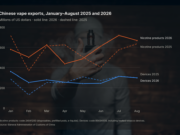
Meanwhile, the vast majority of vape devices used worldwide are still supplied by Chinese manufacturers. Therefore, these firms produce goods for domestic use but also export to international markets, adapting their production to the regulatory environments of different regions, such as Europe, the UK, and North America.
The result is a split system: Innovation and Variety for export markets and a relatively generic, formulaic, and tightly regulated product offering for domestic consumers.
That divergence has major implications for harm reduction. Although tobacco users in other countries might have attractive alternatives to smoking, we find that Chinese consumers face many fewer escape routes from combusted tobacco.
Standards and access should be mutually inclusive
The ranges of the standards for burning cigarettes and nicopods are technically wide and complex. They include everything from materials and composition of the consumable sticks to electrical safety testing in electronic devices, performance testing, and labeling for heated tobacco.
The same goes for nicotine pouches, which have only recently come under China’s regulatory purview. The proposed rules address nicotine content, raw materials used, limits on contaminants and other impurities, and manufacturing consistency, effectively translating numerous high-level regulatory concepts into concrete, enforceable technical specifications.
Standardization is, of course, viewed positively from a public health perspective, as it guarantees product quality, limits variation, and lays a basis for supervision. However, these advantages still amount to theory without access. In China’s case, standards are being created with no clear route to consumer availability.
Innovation under the monopoly model
China is also changing how innovation happens by incorporating novel nicotine products into the mainstream tobacco control policy. Instead of a competitive, consumer-oriented setting, development becomes more centralized and targeted towards state interests.
This is in contrast to what has been observed in countries such as New Zealand, where consumer access to vaping through regulation has been associated with more accelerated declines in smoking prevalence. Their innovation was guided by user demand and competitive market, not state planning.
Innovation will carry on in China—only with restrictions. Consumer-choice demands that brand alternatives to smoking be informed by consumer preferences, but product design, distribution, and branding will likely reflect the needs of a state monopoly.
China’s regulatory direction is not limited to the homeland. As the driving force behind the global vaping supply chain, any increase in standards, licensing, or manufacturing restrictions would not affect product availability or prices worldwide.
While mandatory standards might lead to greater consistency and safety by exerting downward regulatory pressure on smaller manufacturers or requiring larger facilities to adopt practices that are effective yet unnecessary for them, they may also decrease flexibility by concentrating production among large-scale medical device firms able to comply with ever-advancing expectations. Slowly but surely, global product specifications may fall under the shadow of the Chinese regulatory norms — especially in heavily regulated markets.
Harm reduction takes a back seat
Chinese manufacturers will also continue to focus heavily on export markets with strong demand and favourable regulatory frameworks that support product diversity—especially flavours, which remain important for adult switching in many markets. The most significant consequence is philosophical. What China is signaling is that harm reduction will not be the guiding principle of its policy. It seems that control, stability, and the state tobacco monopoly’s shielding are the first considerations.
So while combustible cigarettes remain easily accessible, products with lower risk have tighter limits on their access and appeal. As always, this tends to deter smokers from switching from smoking, having especially profound public health implications for a country with one of the largest populations of smokers globally.
China’s changing nicotine policy needs to be defined as both integrated and controlled. By placing tight squeezes on domestic product availability within a framework of slowly emerging technical standards, authorities appear to be betting that they can define new product categories however they like. Meanwhile, the global harm reduction community is quick to point out that innovation and access are equally important. China could keep the global vape industry running, but at home, it will be less about technology and more about policy choices still to come.